The Cistercian Order was one of the most important new religious orders to emerge in the late eleventh century. The Cistercians dominated religious life in the first half of the twelfth century. They were also one of the most conspicuous orders, for they wore the white habit, rather than the traditional black monastic habit, their churches were strikingly bare and simply furnished, they observed a strict diet and – in order to live by the fruits of their own labour – dedicated much of their time to manual labour. The Cistercians had their admirers, their critics and those who were simply curious. The following selection of quotations reflects the opinions of a variety of their contemporaries, including Benedictines, clergy and laity, friends, foes and satirists; it also includes several quotations from the Cistercians themselves, reflecting how some of the White Monks perceived the Cistercian life.
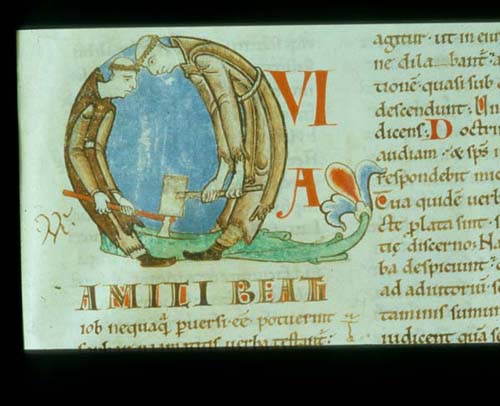
[Dijon, Bibliotheque Municipale MS 170 f 59r] © Bibliotheque Municipale, Dijon
The Benedictines on the Cistercians
… such a great multitude of men has flocked there that sixty-five abbeys have been founded from it (Cîteaux) all of which with their abbots are subject to the chief abbot of Cîteaux. All dispense with breeches and lambskins, abstain from eating fat and flesh-meat and by the great good they do shine out in the world like lanterns burning in a dark place. They maintain silence at all times and wear no dyed garments. They toil with their own hands and produce their own food and clothing.
[Orderic Vitalis, monk of St Évroul, Normandy, writing c. 1135 (1)]
In his days (Henry I’s reign) began the Cistercian Order, which is now both thought and said to be the high road of supreme progress toward Heaven. … Cîteaux … now so famous for continuing monastic vacations that it might well be supposed to have some link with Heaven itself … But to sum up all that has been said or can be said about the Cistercians, they are today an example for all monks, a mirror for the zealous, and a gadfly for the easy-going.
[William of Malmesbury, Benedictine monk of Malmesbury, England.(2)]
O new race of Pharisees brought back to the world, dividing themselves from others, preferring themselves to all the rest
[Peter the Venerable, abbot of Cluny.(3)]
They especially favour white in their habit and thereby seem remarkable and conspicuous to others. Black represents humility in many places in Holy Scripture; therefore up to now monks in their devotion have chosen to wear that colour. Now, however, as if to make a show of righteousness, the men of our time reject black which the earlier fathers always adopted as a mark of humility.
[Orderic Vitalis, monk of St Évroul, Normandy.(4)]
As a White monk on common fare I’d mess but they provide two well-cooked relishes. They hate, what I have ever sorely hated a peasant’s holding near their own located. They lust for land, these plaguey folk, and groan if neighbours’ fields set limits to their own. Enough of milk and wool their beasts provide. But with enough they’re never satisfied. Always encroaching though their needs be scant had they the world they’d still be in want. They’ll feed me well while I’m a novice yet, but keep me busy, for to all are set their special tasks, lest any seem to be slothful, or lacking share in industry. A Sabbath-rest is rare, for with less work there’s less to eat – good reason not to shirk. The rod’s in frequent use, the diet’s rough; unappetising fare’s though good enough. Never flesh-meat save one in high position, abbot or prior, kindly gives permission. Strong meat of four-foot beasts the Rule denies; so flesh of bird that runs or bird that flies they long for, not as tasty but as rare. But when they cook it, no-one dwelling near perceives the smoke, too conscious of the act. The meal all done, no vestige of the fact remains, for lest the chicken-bones be found crying, “We’re here” they‘re buried underground. To all are given three tunics by right, two cowls and a short scapular – by night no drawers impede them as they lie in bed, no fear lest I be thus inhibited.
[Nigel Wireker, Mirror for Fools, late twelfth-century satire on the religious orders; Nigel was a monk of Christ Church, Canterbury.(5)]
They bar their gates and keep their private quarters completely enclosed. They will not admit a monk from another religious house to their cells, nor allow one to come with them into the church for Mass or any of the offices.
[Orderic Vitalis, monk of St Évroul, Normandy, writing c. 1145.(6)]
How is it possible for monks fed on poor vegetable diet, when even that scanty fare is often cut off by fasts, to work like common labourers in the burning heat, in showers of rain and snow, and the bitter cold? Besides, it is unbecoming that monks, the fine linen of the sanctuary, should be begrimed in dirt and bent down with rustic labours.
[Peter the Venerable, abbot of Cluny.(7)]
Seculars on the Cistercians
The black monks … have acquired in our days certain new imitators who profess the same rule and – more fervent in spirit – add thereto some stricter ordinances of their own. These men we call white or grey monks … The white monks wear the woven wool just as the sheep did, innocent of any dye, and though they taunt the black monks for their lambskins, they themselves are provided in equally good measure with numbers of comfortable habits, such as would become costly scarlet for the delight of kings and princes if they were not snatched from the dyer’s hands.
[Walter Map, archdeacon and satirist, writing in the late twelfth century.(8)]
There is a highly tested school of religion, the highest use of modesty, regularity of ways, feeling of fraternity, peace of soul, communion of all men, mutual complaisance, vigour of discipline, love of obedience, bond of turnal watches, quiet of meditation and devotion of psalmody.
[Peter of Blois, archdeacon of Bath and London.(9)]
What they may have purposed or promised in the bud, I know not: but whatever the promise was, such a fruit has followed that makes you fear the tree.
[Walter Map, archdeacon and satirist.(10)]
‘… that perfect rule of Cistercian life which is now the marvel of almost the whole church.’
[Thurstan, archbishop of York (11)]
… they obtain from a rich man a valueless and despised plot in the heart of a great wood, by much feigning of innocence and long importunity, putting in God at every other word. The wood is cut down, stubbed up and levelled into a plain, bushes give place to barley, willows to wheat, withies to vines; and it may be that to give them full time for these operations, their prayers have to be somewhat shortened. …and so all the whole earth is full of their possessions; and though the gospel does not permit them to take thought for the morrow, they have such a reserve of wealth accruing from their wealth that they could enter the ark in the same spirit of security as Noah who had nothing left outside to look to.
[Walter Map, archdeacon and satirist.(12)]
What shall they answer who seize other men’s goods and have then given them away in alms? They will say: ‘O Lord, in they name we have done charitable deeds, we have fed the poor, clothed the naked, received the stranger at the gate.’ The Lord will answer: ‘You speak of what you have given away, but you do not mention the fact that you have stolen it in the first place. You are mindful of those whom you have fed, but you have forgotten those whom you have destroyed.
[Gerald of Wales, archdeacon of Brecon and satirist.(13)]
… settle the Cistercians in some barren retreat which is hidden away in an overgrown forest: a year or two later you will find splendid churches there and fine monastic buildings, with a great amount of property and all the wealth you can imagine.
[Gerald of Wales, archdeacon of Brecon; satirist and reformer.(14)]
For where they plant their foot they destroy villages, take away tithes and curtail by their privileges all the power of the prelacy.
[Archbishop Pecham of Canterbury, late thirteenth century – letter to Edward I.(15)]
He lauded the Order to the skies � there was only one matter in which the Cistercians displeased God: when it came to lands made over to them, they exercised their rights too freely and, more intent on law than on justice, seemed insufficiently mindful of their duty to those men committed to their lordship. In all else he said that they were like angels of God: in their renunciation of food and clothing, in discipline, in charity � in the practice of every kind of holiness to please him whose appropbation they desired.
[Wulfric of Haselbury, twelfth-century recluse (17)]
How the Cistercians saw themselves
Our food is scanty, our garments rough; our drink is from the stream and our sleep upon our book. Under our tired limbs there is a hard mat; when sleep is sweetest we must rise at a bell’s bidding … self-will has no scope; there is no moment for idleness or dissipation … Everywhere peace, everywhere serenity, and a marvellous freedom from the tumult of the world. Such unity and concord is there among the brethren that each thing seems to belong to all and all to each …To put all in brief, no perfection expressed in the words of the gospel or of the apostles, or in the writings of the Fathers, or in the sayings of the monks of old, is wanting to our order and our way of life.
[From an account of the joys and hardships of Cistercian life by a novice under Aelred of Rievaulx.(18) ]
Our ordo is debasement, humility and voluntary poverty. It is obedience, joy and peace in the Holy Spirit. Our ordo is to be under a master, under an abbot, under a rule, under discipline. Our ordo is to be zealous for silence, to practice fasting, vigils, prayer and manual work, and above all to keep to the more excellent way of charity. Moreover, it is a matter of making progress from one day to the next, and to persevere in them until the final day.
[From Bernard of Clairvaux’s letter to the monks of St Jean d’Aulps.(19)]
For their name arose from the fact that, as the angels might be, they were clothed in undyed wool, spun and woven from the pure fleece of sheep. So named and garbed and gathered together like flocks of seagulls they shine as they walk with the whiteness of snow.
[Walter Daniel, monk of and biographer of Aelred.(20)]
Trampling the flowers of the world with the foot of forgetfulness, counting riches and honours as dung, beating with the fist of conscience on the faces of mutable things, spurning fleshly desires and vain glory in food and drink…. Using only so much and such means of sustaining life as will just maintain the needs of the body.
[The early Cistercians, as described by Walter Daniel, a monk of Rievaulx. Walter Daniel, Life of Aelred, p.11]
It seemed to him that the food and drink were tasteless, the clothing scratchy and cheap, the manual labour hard, the vigils and chants burdensome, and the tenor of the whole Order too austere… he debated quitting the Cistercians and turning back to the canons.
[Waldef, former prior of Kirkham, later abbot of Melrose Abbey (21)]
We put great effort into farming which God created and instituted. We all work in common, we (choir monks), our lay-brothers and our hired hands, each according to his own capability, and we all make our living in common by our labour.
[The Cistercian monk in Idungus of Prufung’s Dialogue of Two Monks.(22)]
References
(1) Orderic Vitalis, The Ecclesiastical History of Orderic Vitalis, ed. and tr. M. Chibnall (6 vols., Oxford, 1969-80), IV p. 325.
(2) William of Malmesbury, Gesta Regum Anglorum, The History of the English Kings, ed. and tr. R. A. B. Mynors, R. M. Thomson and M. Winterbottom (2 vols., Oxford, 1998-9), I, pp. 577, 581, 585.
(3) Peter the Venerable, The Letters of Peter the Venerable, ed. G. Constable (2 vols., Cambridge Mass., 1967), I, ep. 28.
(4) Orderic Vitalis, Ecclesiastical History IV, pp. 311-313.
(5) Nigel Wireker, Mirror for Fools: The Book of Burnel the Ass, tr. J. H. Mozley (Oxford, 1961), p. 62
(6) Orderic Vitalis, Ecclesiastical History, IV, p. 326. Peter the Venerable, abbot of Cluny, wrote to Bernard of Clairvaux in 1149 voicing his frustration at the Cistercians’ unwillingness to let Black monks into their cloisters, and suggested that if they were more open diverse customs would not separate these and those monks, whom the same faith and charity should truly make brothers, Peter the Venerable, Letters I, ep. 150.
(7) Patralogia Cursus Completus Series Latina, ed J. P. Migne (221 vols., Paris, 1844-65), CLXXXIX, col. 112 ff (Petrus Venerabilis, Epistolarum libri sex (XXVIII); cited in F. Mullin, A History of the Cistercians in Yorkshire (Washington, 1932) p. 4.
(8) Walter Map, De Nugis Curialium, ed. and tr. M. R. James, rev. C. N. L. Brooke and R. A. B. Mynors (Oxford, 1983), p. 85.
(9) Cited in G. Constable, The Reformation of the Twelfth Century (Cambridge, 1996) p. 106.
(10) Walter Map, De Nugis Curialium, p. 77.
(11) From his letter to William, archbishop of Canterbury, translated by A. W. Oxford in his The Ruins of Fountains (London, 1910), pp. 137-163, at p. 162.
(12) Walter Map, De Nugis Curialium, pp.75, 87
(13) Gerald of Wales, Journey through Wales, p. 104.
(14) Gerald of Wales, The Journey through Wales / Description of Wales, tr. L. Thorpe (Harmondsworth, 1978), p. 104.
(15) Cited in J. S. Donnelly, ‘Changes in the grange economy of English and Welsh abbeys 1300-1540’, Traditio 10 (1954) pp. 399-458, at p. 409.
(16)
(17) From John of Ford’s Life of Wulfric, translated in The Cistercian World: Monastic Writings of the Twelfth Century, ed. and tr. P. Matarasso (Harmondsworth, 1993), pp. 231-273, at pp. 253-4.
(18) Aelred of Rievaulx: The Mirror of Charity, tr. E. Connor (Kalamazoo, 1990), II 17: 43 (p. 194); for the Latin see Speculum Caritatis, I: 17; PL cxcv, cols. 562-3.
(19) Bernard of Clairvaux, The Letters of St Bernard of Clairvaux, tr. B. S. James, rev. B. Kienzle (Stroud, 1998), ep. 151 (pp. 219-221).
(20) Walter Daniel, Vita Aelredi, The Life of Aelred of Rievaulx, ed. and tr. F. M. Powicke (Edinburgh, 1978), p. 5.
(21) Jocelin of Furness, Life of Waldef tr. McFadden, bk.1, ch. 11:34 (p.240)
(22) Idungus of Prüfung, Cistercians and Cluniacs: the Case for Cîteaux [A Dialogue between Two Monks; an Argument on Four Questions], ed. and tr. J. O’Sullivan and J. Leahey (Kalamazoo, 1977), II: 52, pp. 93-4.