The Dissolution of the monasteries by Henry VIII (1509-47), brought an end to monastic life in England and Wales; Scotland’s monasteries continued until the rejection of papal authority there in 1560. Through the Act of Supremacy in 1534 Henry VIII declared himself the head of the Church in England; any who opposed this were charged with treason. Henry sought to assess the state of monastic life in the country through a rigorous investigation of every house. This was said to be in order to uncover and suppress dissolute living, but the need for money lay behind these pious motives.
Henry first ordered an evaluation of all the property belonging to the church in England and Wales; this survey, known as the Valor Ecclesiasticus, estimated that the monasteries had a net income of £320 000, although the real figure was probably closer to £400 000, ten times greater than the Crown’s annual income. Thereafter, the king sent commissioners to conduct a gruelling visitation of every religious house and compile a report of their reprehensible conduct. Their findings were entered in the infamous ‘Black Book’, which was read before parliament in 1536. This gave a distorted picture of monastic life, reporting that two thirds of the monasteries were filled with debauchery; however, it provided the king with the necessary ammunition to effect the first stage of the Dissolution – the suppression of houses with an annual income below £200.
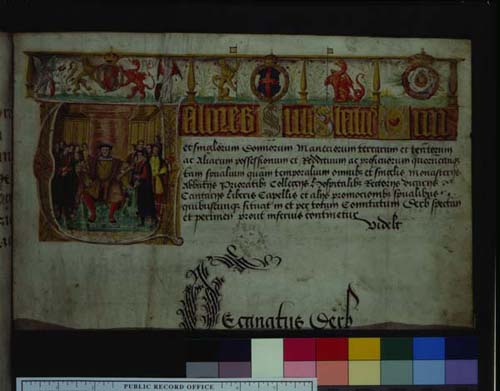
[PRO E 344/22] © The Public Record Office
Following the deaths of some two hundred insurgents in 1537, measures were taken to effect the suppression of the greater houses. Commissioners used persuasion, coercion or force to obtain the ‘voluntary surrender’ of each community, and in chapter- houses throughout the country monks appended their names to surrender deeds, sealing their fate. Keys were handed over to the commissioners, the monastery’s possessions allocated to the Crown, and the monastic buildings destroyed to prevent any attempt at a revival. In 1539 Henry legalised and legitimised his actions by an Act of Parliament.
The sheer speed with which the surrender and destruction of the abbeys took place was phenomenal, and must have been overwhelming – and unnerving – to monks and the laity alike. A fully furnished church, filled with celebrants one Sunday could be, quite literally, reduced to a desolate mass of ruins the next. The destruction of these sites left a void in the spiritual life of Britain, as well as the landscape. It also had an impact on hospitality and charity that was administered by the monks, and employment. There were some, however, who sought to benefit from the situation. Speculators bought monastic lands at the Crown’s price and sold them at a considerable profit; others pilfered from the sites, stealing away with broken stone, timber or grave goods.
What happened to the monks who were driven out of their homes? Some, though not all, received pensions, and many became parish rectors. As a punishment for their involvement in the uprising, none of the monks of Jervaulx received a pension; others, like Marmaduke Bradley, did very well. Bradley, the last abbot of Fountains, had complied with and bribed the royal commissioners, and received a sizeable pension that would have enabled him to live in comfort. There is evidence of some solidarity amongst those who had once been united within the Cistercian family. In 1555, some fifteen years after the suppression, Henry Cundall, last abbot of Roche assembled five of his former monks, as well as the last abbot of Rievaulx and some monks of Rufford, to sign letters of recommendation for a former monk of Roche, Richard Moysleye, who wished to be ordained a priest.(1) Others, like Edward Heptonstall, carried hopes of a revival. Edward, a former monk of Kirkstall, had seemingly retained the abbey’s books after the Dissolution, and in 1558 he stipulated that his executors should return these to Kirkstall if the religious houses reformed(2).
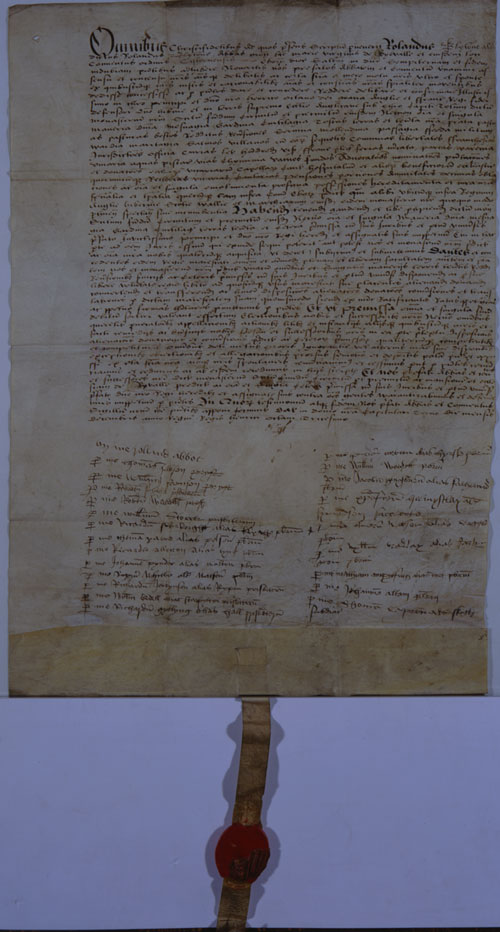
[PRO E 322/202] © The Public Record Office
References
(1) C. Cross, Monks, Friars and Nuns in Sixteenth-Century Yorkshire, Yorkshire Arch Soc. Rec. Ser. 150 (Huddersfield, 1995), p. 9.
(2) Ibid.